Jazz Is an Art Form Creatied by Arican Americans
Black History, and Jazz Music in America, a story
On this date, we focus on Jazz Music in America and the Black culture's part in creating and influence its existence.
Jazz is an American musical grade, frequently improvisational, adult past Blacks and influenced by both European harmonic structure and African rhythmic intricacy. Information technology is often characterized by its use of blues and voice communication intonations. Although it is not known exactly when jazz emerged, at that place were plantation contumely bands as early as 1835, and minstrel troupes were touring by the 1840s. Ragtime, syncopated music that took its formal structure from the march, adult in the 1880s and is thought of as the precursor of jazz.
Composed piano rags (music) by Scott Joplin and others achieved wide popularity at the close of the nineteenth century. (The "stride" style of pianists such every bit James P. Johnson and Fats Waller soon followed every bit an E Coast development of ragtime.) The earliest jazz band style developed in New Orleans, a city with a long, racially mixed, cultural tradition. Starting in the belatedly 1890s, Charles "Buddy" Bolden's band is thought to take played ragtime with improvised embellishments, and by the plough of the century, many New Orleans bands were playing in a collective improvisational style. I of them was the Superior Band which included Bunk Johnson.
The Original Dixieland Jazz Ring, a white group, copied Superior's style and was the first to tape (1917). Leading early 1920s groups included the New Orleans Rhythm Kings, and the Jelly Roll Morton and King Oliver bands, whose music was more smoothly flowing than ragtime. Jazz at this time included improvised solos, which in the playing of Louis Armstrong (trumpet) and others led to the development of the Chicago style in the afterwards 1920s. Larger ensembles started upward often using written orchestrations. The manner of jazz known equally Swing followed with groups led by Fletcher Henderson (with scores past Don Redman), Paul Whiteman (with Bix Beiderbecke), Chick Webb, Jimmie Lunceford, and Bennie Moten.
Swing is characterized by a regular rhythm and the contrasting sounds of the sections of the band. Swing culminated in the music of groups led by Count Basie, Benny Goodman, Artie Shaw, and the Dorsey brothers. Through the activities of such men as Art Tatum (piano), Roy Eldridge (trumpet), and Lester Young (tenor saxophone), solo improvisation grew in influence during this period. Add together to this the insertion of voice (in detail) Billie Holiday and Ella Fitzgerald, generally considered to exist the greatest singers in the history of jazz. One of the about important of the late swing musicians was Duke Ellington, who, like Morton in the New Orleans style, shaped his musicians' improvisations on his original themes into strongly colored, finely balanced compositions.
The tradition of composing continued through later phases of jazz, in the work of Thelonious Monk, John Lewis, George Russell, and others. Bebop, or bop, was the start important postwar style. Its main developers were Charlie Parker (alto saxophone) and John Birks "Dizzy" Gillespie (trumpet). Their improvisations on chord changes played against unpredictable accents and multifaceted cantankerous-rhythms and had a new intensity. Cool jazz, some of which, like the playing of Stan Getz (tenor saxophone) and the ensembles of Cannonball Adderley (saxophone), arose out of Lester Young's music, adult partially equally a reaction against bebop.
Other mail service-bop developments included the music of Lennie Tristano (pianoforte), the Modern Jazz Quartet, Gil Evans, Miles Davis (trumpet), and others. A less formal blazon of group interaction was evident in such bands every bit those of Horace Silver and Fine art Blakey, together with a stronger accent on the blues and greater prominence for the drums, in a music that was called difficult bop. Equally jazz continued to evolve, inventiveness by Russell, Tristano, and Charles Mingus added even more variations of both rhythms and melody. Davis introduced modal jazz in his recording Kind of Bluish (1959).
In the late 1950s and '60s Ornette Coleman (alto saxophone), John Coltrane, Albert Ayler (tenor saxophone), and others developed a new emotional intensity in their playing, rejecting conventional jazz harmonies and melodies in favor of screeches, wails, and soaring cascades of notes played against irregular but driving rhythmic backups. This highly influential fashion became known every bit gratuitous jazz.
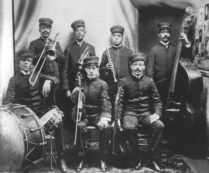
(The Superior Jazz Band, 1910)
In moving abroad from European influences, jazz attained with Don Ruby, Don Ellis, and others inserted fusions with the music of other cultures, specially the music of India and the Arab world. A counter trend during the 1970s was the utilize of technology, particularly rhythmic ones, taken from rock. This led jazz musicians to experiment with electronic instruments. The about successful were Miles Davis' later bands, and the Conditions Report, Render to Forever, and the Mahavishnu Orchestra. A different trend resulted, an unaccompanied improvisation by melody instruments.
The tradition of the gratuitous jazz of the 1960s was carried on by pianist Cecil Taylor and by groups such as the Fine art Ensemble of Chicago into the 1980s. This techno-based manner of jazz is too called fusion; a popular form of music developed in the 1970s. Its master characteristics are drumming styles and instrumentation of rock music going with improvisation with a stiff accent on electronic instruments and trip the light fantastic toe rhythms. Although various jazz musicians began to include at least some jazz-rock in their performances and recordings no matter what their basic style, a few who made significant contributions earlier the 1970s too created original styles inside jazz-rock as well, notably onetime Miles Davis associates pianist-composers Herbie Hancock, Chick Corea, and Joe Zawinul; saxophonist-composer Wayne Shorter; and guitarist John McLaughlin.
This style gained one of the largest jazz audiences since the swing era concluded in the mid-1940s. As with swing-era big bands, those jazz-rock groups presenting the least improvisation tended to enjoy the about acclaim. The style was also known as "cross over" because sales of the music crossed over from the jazz market to the pop music market. Jazz-stone provided a new musical vocabulary stemming in part from that offered by John Coltrane and sometimes from mod concert music as well as stone.
To this mean solar day jazz remains always-evolving with tradition being firmly established past composers, singers, and players who understand its history while embracing jazz's base of continuous development. Some of those carrying the torch are Wynton Marsalis, Roy Hargrove, Marcus Roberts, Bobby McFerrin, and others.
Jazz (as a cultural expression), has greatly influenced society. It remains on the outskirts of the public eye of contemporary American recognition and acceptance. This is consistent with its Blackness origins and mentoring.
To Become a Musician or Singer
To Become a Conductor or Composer
Source: https://aaregistry.org/story/jazz-music-and-an-african-american-art-form/
0 Response to "Jazz Is an Art Form Creatied by Arican Americans"
Post a Comment